Published: Monday 2nd March 2026
Get disabled people into work
The Government have published various papers and plans on the subject of getting more disabled people into work. As a Civil Servant, I must remain politically neutral, so this post is not intended to give my opinion on this policy. However, as a disabled person, I would like to share some thoughts on the reality of working with a disability.
In November 2025, the Government published a paper called The Employment of Disabled People 2025  . In this paper, it says that 52.8% of disabled people have a job, compared to 82.5% of non-disabled people. It then goes into more detail, comparing different disabilities and multiple disabilities in relation to employment.
Getting a job
I think we need to be realistic. Disability is a very general term and every disabled person is an individual. We all have different combinations of health and physical factors, as well as other factors, which affect our ability and desire to get a job. There will always be a significant group of disabled people, who cannot work. In my opinion, they have enough to deal with. We should look after them, ensure they are financially protected and not pressure them to do the impossible.
I tend to think of this issue as a quadrant diagram.
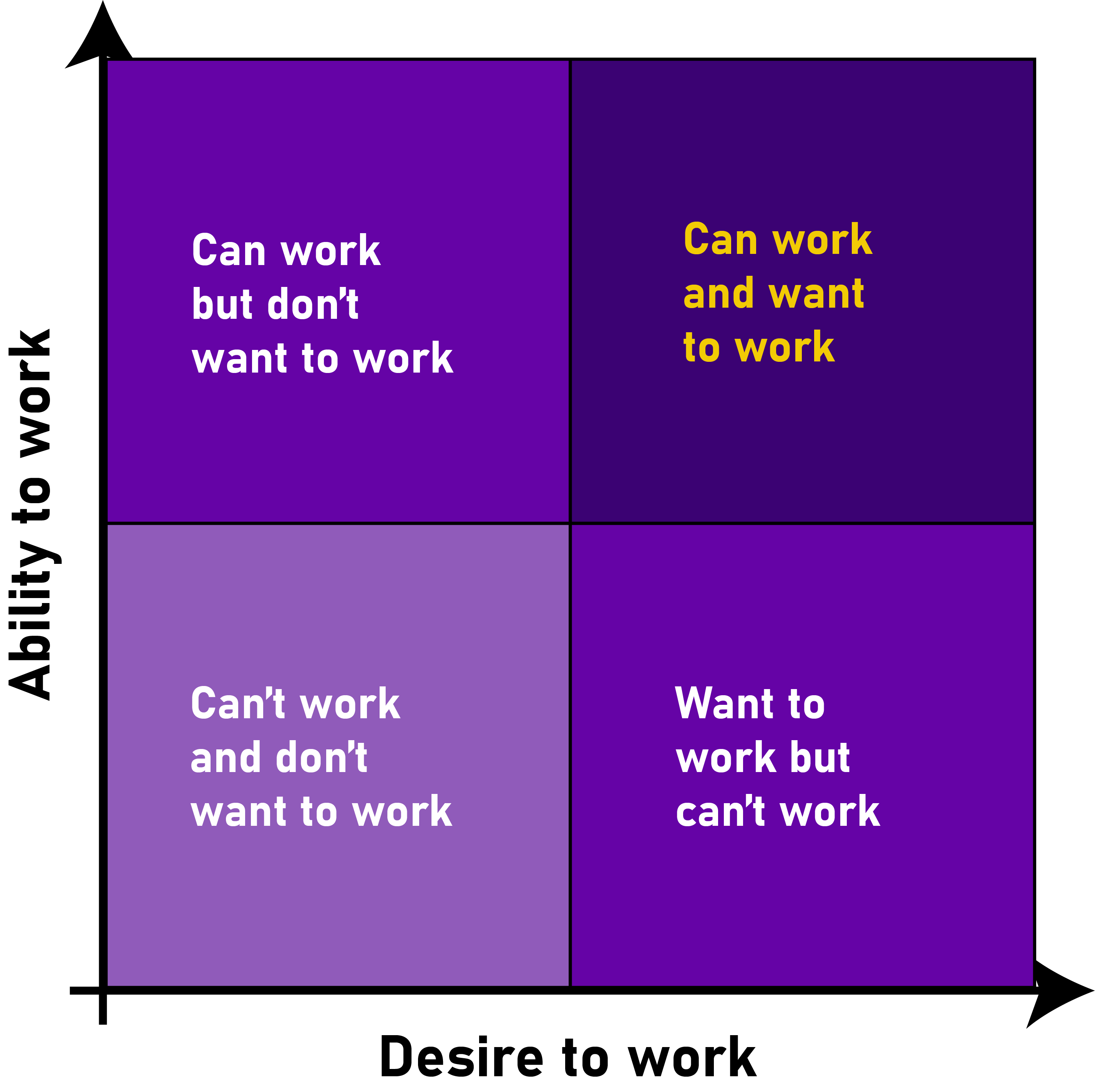
What we don't know, is what proportion of disabled people are in each quadrant. Of course, some will be on the borders between quadrants, where some days they are more capable or more willing to work than others. So this is a very crude model.
The group I am most concerned with is those that want to work, especially those who want to work and are capable of work. I would love to know what the rate of employment is, just for this group. I have a hunch that there are disabled people who are capable of work and want to work, but they are struggling to get the right job.
The employer responsibility
In the UK, we have the Equality Act (2010), which should protect people with protected characteristics (disability is one of nine protected characteristics) from discrimination, harassment and victimisation. It should mean that disabled people are not discriminated against when they apply for a job but the reality can be somewhat different.
I have had pretty good experiences when applying for jobs, but I've had at least one interview, where I didn't get the job and I'm pretty sure my wheelchair was the issue. They were very proud of their newly installed accessible toilet... right until I tried to get to it and found the corridor too narrow to get a wheelchair through. The interview went really well but I didn't get the job.
Getting a job often involves a long recruitment process. Each stage can present barriers to disabled people. Employers have a duty to proactively remove these as much as possible. Let's take each stage, one at a time:
- Job advert - The advert should be accessible, including for assistive software users. It should be worded clearly and set out clear criteria for those applying. It should be clear what the salary is and whether that is fixed or a range. The advert is a good place to make a statement about inclusion. I'm more likely to apply for a job, if it states that they welcome applications from disabled people.
- Application - The application form should be accessible and allow people to save and return to it. It should be clear what information is required in each section. It should allow the user to format text, so that they can structure it well. Blocking the use of things like bullet points or bold text can make it difficult to check through and edit.
- Interview - Reasonable adjustments should be offered up front. These might include providing questions in advance, giving extra time or a break. For online interviews, it might be easier but if the interview is face to face, then providing accessible parking and considering getting into and around the building would be needed.
- Presentation or task - I think a well thought out task is the best way of assessing candidates. The task should closely reflect the work that will be done if the candidate is successful. Instructions should be clear and let them know how they will be assessed or scored. Many employers ask for a presentation. I think this is only useful, if presenting will be part of the job. If not, it's a potential barrier to someone who can't present well but would be good at the job.
- Job offer - This is often done by phone but employers should consider how to communicate best with people who can't use the phone, maybe because they are deaf or cannot speak clearly. If salary is negotiated, it should be clear how this works. Employers need to be very careful not to discriminate through pay. Pay should reflect experience, skill and performance, not disability!
- Feedback - For unsuccessful candidates, good quality, honest feedback is essential. As a disabled person, I think this is severely lacking. Employers don't want to offend, so they give weak feedback like, "You were so close. There was just another candidate who had a bit more experience." What use is that?!! If the candidate needed to perform better, at least tell them what they did wrong or what they missed out!
The employee responsibility
I have had a lot of good luck in applying for jobs... but I've also had my fair share of disappointments. When we moved back to the UK from Finland, I had many job interviews. I'd been teaching for 20 years, had the qualification for being a head teacher and I was successful in writing good applications. I got lots of interviews.
I struggled though to get a job. Eventually, I got a basic teaching job, which I took and gave my best shot. After nine months, I realised it was unsustainable. I was exhausted, unhappy and felt like my life's purpose had evaporated.
I had to take responsibility and reevaluate my career. Teaching was just not compatible with my disability. I needed to find something different. I tried a few tweaks, like teaching English as a foreign language to adults... but it just wasn't right.
I wanted to stay in education but I needed to find a job with normal hours, not too physical, flexibility and some allowance to work from home. I decided that eLearning would be a good option but I knew I needed some training if I were to do that. I was lucky that I found a job managing adult learning centres for my local authority, and that gave me financial security to allow me to study part time. It took four years but I got my Masters in Online and Distance Education, and this set me up for what happened next... which was really positive.
My point here is that I could have just given up. I could have retired from teaching on health grounds and accepted my fate. I had to take responsibility, be prepared to change career, be prepared to study, to do whatever I was able to do in order to make employment possible again.
Benefits of working with a disability
I'll be honest, I have some days when I question whether work is really sustainable for me. Pain, fatigue and barriers often leave me in despair. However, I do enjoy my work and it does bring me some massive benefits.
Let's start with the most obvious benefit of all - pay. Being disabled is expensive. A new pair of decent shoes might cost £50. Replacing my wheels costs £2,400. Of course, I could buy cheaper wheels but Loopwheels have amazing suspension, which reduces vibrations and helps keep my back in better condition. If I need something to help manage pain, make life easier, even just take a break, I can usually sort it... because every month, I get paid.
One of my biggest frustrations of living with a disability, is the constant low expectations on me. People assume I'm weak, helpless and that I have little to contribute. At work, the exact opposite is true. When I'm at work, expectations are high... very high. I'm expected to perform, to deliver, to achieve. People are accommodating and I have adjustments in place to help me be the best I can be. But at work, I feel like I have worth. I make things happen. I help others, instead of being the helpee all the time.
Like many neurodivergent people, I need routine. My day has to have some kind of structure to keep my mental health strong. Work is a really good way to provide a daily routine. Okay, so my work routine is different from most other people's. Here's a breakdown of my day:
- 06:00
- Start work, check emails, say hi to my team on Teams
- 06:30
- Work on something creative or that needs to be produced and where I don't want any distractions
- 09:00
- Walk Liggy while I mentally plan or think through a difficult situation
- 09:30
- Morning meetings and/or work that I can easily break off
- 12:00
- Lunch - usually either a bacon sandwich or a salad
- 12:30
- Check and respond to emails
- 13:00
- Afternoon meetings and work that doesn't need too much concentration
- 15:30
- Shut down laptop and finish work
I am fortunate that my employer encourages flexible working. I keep a flexi sheet, so if I start a bit earlier than normal or work a bit later than usual, I can take that time back later. Sometimes, I can finish early or take a day off. I try to use this when I'm tired or in pain and need to rest. Feeling like I have some control over my daily routines is a definite benefit of working.
Challenges of working with a disability
For me, the biggest two challenges by far, are pain and fatigue. I have to put a lot of effort and planning into keeping my pain manageable and sometimes, no matter what I do, the pain is too much. I also have limited energy (spoon theory) and once my energy is gone, I really struggle to get through the day. I think these are quite normal issues though for many disabled people.
My next challenge is sort of linked to that. It's the balancing act that is needed to juggle a career with health. There are times when I ought to see a GP but I don't because it is so difficult to get an appointment. Our surgery still requires a phone call, at 8:00 on the dot. The last two times I've done that - both in urgent situations - there have been no appointments left and I've had to wait days to see a doctor.
When a referral is needed, that often results in appointments in work time. In theory, I can take time off for these... and I do... but the reality is that too many appointments can have a negative impact on my team, on my work, and on people's perception of me.
I often feel like I have to choose between having a successful career or taking care of my health. That's not because of my employer. It's because healthcare is not geared to people who work.
My final challenge is actually not a work issue. It's things like this...
Last week, I walked Liggy. We took our usual route but I was more conscious of time because I was interviewing a candidate for a job at 9:30. As we came out of the cemetery and turned towards home, I realised the pavement was completely blocked. The gas company had arrived and were digging up the pavement. They hadn't got fully organised and had prioritised road traffic, setting up temporary lights. I couldn't cross over because there aren't dropped kerbs on the other side. I was stuck and couldn't get home.
I kind of froze for a moment, wondering what to do. I contemplated taking a photo of the situation and WhatsApping it to my colleague with the caption, "Sorry, I'm going to be late," but that didn't seem fair on the candidate. Eventually, I decided my only option was to become a vehicle. I knew that would annoy drivers who had already had to wait at the temporary lights, but it was tough luck. So I went into the road and positioned Liggy and I behind a waiting car. When the lights went red, I gave Liggy a rather unusual command to run and we went as fast as we could for the 100m or so through the single lane, until I could get back on a pavement.
This time, a solution existed. Sometimes, I'm not that lucky.
Summary
Getting a job, keeping a job, being successful in a career and maintaining some degree of health is difficult. I find it difficult and I'm in that quadrant of "Can work and want to work." I find it difficult and I'm on a relatively good salary. I find it difficult and I have a supportive family, who try to make my life as manageable as possible. I find it difficult with everything going in my favour.
I love my job and I love working but I doubt that I could do this until state pension age (67 for me). I'm already looking at my plan towards early retirement and putting in place sufficient measures to get me through the next few years.
If I enjoy working, want to work, value my work and have everything going for me... and yet still find it difficult, how much more are those who don't want to work or can't work going to find it? How difficult will it be for those who can only find low paid work? How difficult will it be for those who have only ever done physical, manual work and can't easily switch to a different career?
I think we need to be realistic. I would love all disabled people to have a well paid, fulfilling career... to pay tax and contribute to society in the way governments want us to. The reality is that for many, it just won't happen. With all the reasonable adjustments that an employer can make, it won't be enough for some. It needs fundamental changes to so many things: healthcare, education, society. Even if the perfect world existed, even then, it would be too difficult for some. I would like to hope that in 2026, a developed country could accept this and take care of those who can't work.
A final idea
Personal Independence Payments (PIP) is not means tested. I get it, even though I work. Some of the things I spend my PIP on, actually allow and enable me to work. Has any government considered giving a PIP uplift to those who work? Living with a disability is expensive. Working with a disability is actually even more expensive. If that were recognised with an additional 'in work' payment, maybe some disabled people who want to work but can't, would be able to buy the equipment or services they need for it to become possible. It's just a thought.